• the Daily hi thread just say hi :)
  • All contentious threads including politics, religion, crime, immigration, laws, elections etc are banned & will be removed. There is still a Gun Related Politics section for relevant topics.

Solar and renewables

I'd put a 500W wind generator on every lamp post, tower gantry, etc complete with its own grid-tied micro inverter.
This would be pretty quiet noise-wise and spread/distribute the power with no cost to the National Grid, using existing infrastructure. Lamp posts would be a cash producing asset to local councils instead of a liability. By having so many the same, production costs would plummet and maintenance a matter of break and replace.
A better solution than solar, which only produces about 11% average power, with virtually none for 16hours per day. eg my house array is 3.7kW max. There are nearly 8200 hours per year, so if the sun shone all the time with no cloud I'd produce about 30 000 kWh. I actually get about 3 200kWh.

Our array is generating 1.2kw, consuming 609w (I am cooking chicken for mum in her airfryer), sending about 400w to the battery as it is at 96%, and exporting about 275w. I think the most I have seen generated is 6.2kw. All the panels on the west side of a bungalow roof for various reasons I didn't think it was worth putting on the east side. Now I am familiar with the tech I think I need 4 or so on that roof as I explained above

I don't think wind has a place in really large scale production as a substitute for power stations. Now on a domestic level yes to top up batteries or just push back to the grid it would be useful. The sun doesn't shine at night, but I know the winds blows in winter bad weather! For me though there is a gap between the domestic and the 'national grid'. I am very much in favour of a return to localised generation as used to be when both the electric and gas grids were laid out. Now this is where ideas like your lamp post vertical turbines come in. My concern is cost against robustness and getting that balance right. The ideal I think would gas powered generators. We could completely distribute the domestic supply.

I would love to put one of these into our battery array set up but it isn't possible. I could see this connected say to a sand battery.


shopping
 
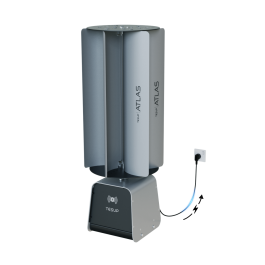
Someone on the DIY solar website has put the Atlas turbine dimensions through a turbine calculator, it has a theoretical maximum of 55 watts, but at a wind speed of 15mph can produce 14 watts. Not quite the 9kw.

This is what a genuine 6kw turbine looks like, note the 5.6 metre diameter blades, tower, and 1.25 ton weight. It costs nearly £30,000.

 
Last edited:
If that thing generates 9kw I'm a Dutchman.
You're quite safe! Not knowing the size though. Such generators have at least 2 severe tradeoffs. They do not need to rotate on a pole so as to point into the wind. They tend to be mounted low down because they have a lot of sideways wind resistance, whereas a propellor has much less. ANd low down gets less wind.
The maximum efficiency is about 40%, as the returning side pushes against the wind. A propellor can be nearly 64% efficient under absolute optimum conditions.
 
Someone on the DIY solar website has put the Atlas turbine dimensions through a turbine calculator, it has a theoretical maximum of 55 watts, but at a wind speed of 15mph can produce 14 watts. Not quite the 9kw.

This is what a genuine 6kw turbine looks like, note the 5.6 metre diameter blades, tower, and 1.25 ton weight. It costs nearly £30,000.

My 500W lamp post idea would need about 1.7.5m diameter, 800mm blades. Very robust as a result The microgenerator would fit into the lamp post as well.
 
You'd have to beef up all the lamposts though, they're not designed for that loading.

The least offensive solution is offshore wind farms, but maintenance is expensive and so is the infrastructure. Here in Wales many dairy farms have wind turbines, I can see three from my garden. They make a tidy sum for the owners, and save fossil fuels for essential duties, like running tractors.

I hope there will be electric tractors soon, seems like an ideal application, no problems with heavy low tech batteries in a tractor, weight is good.
 
You're quite safe! Not knowing the size though. Such generators have at least 2 severe tradeoffs. They do not need to rotate on a pole so as to point into the wind. They tend to be mounted low down because they have a lot of sideways wind resistance, whereas a propellor has much less. ANd low down gets less wind.
The maximum efficiency is about 40%, as the returning side pushes against the wind. A propellor can be nearly 64% efficient under absolute optimum conditions.
I don't think he quiet grasps that these things are sold on optimum performance to those who expect a lot less.
 
My 500W lamp post idea would need about 1.7.5m diameter, 800mm blades. Very robust as a result The microgenerator would fit into the lamp post as well.
As @Catweazle has said lamp posts are not designed to take any sort of load at all, many suffer from the wind with just a lamp and get blown sideways. You can just about get away with a small (600mm) sign low down. Of course most lamp posts are in urban areas and sheltered from wind although those on motorways are better suited if you disregard access for maintenance and concerns about what might happen when one gets struck in a crash.
 
I don't think he quiet grasps that these things are sold on optimum performance to those who expect a lot less.
If "he"refers to me then I confess that I don't understand the logic of paying loads of money for a "9kw" turbine that generates 14 watts.
 
Windmills are useless for large scale production. We do need fewer here.
We should be manufacturing hydrogen that can be manufactured by the energy from Windmills in off-shore plants. It can be manufactured cleanly, easily stored and burns cleanly and could be used across the spectrum from heating homes, transportation and generating electricity.
 
We should be manufacturing hydrogen that can be manufactured by the energy from Windmills in off-shore plants. It can be manufactured cleanly, easily stored and burns cleanly and could be used across the spectrum from heating homes, transportation and generating electricity.
But at an efficiency of about 15%. And when it goes wrong the consequences are grave. I believe a trial "up North" was abandoned.
 
As @Catweazle has said lamp posts are not designed to take any sort of load at all, many suffer from the wind with just a lamp and get blown sideways. You can just about get away with a small (600mm) sign low down. Of course most lamp posts are in urban areas and sheltered from wind although those on motorways are better suited if you disregard access for maintenance and concerns about what might happen when one gets struck in a crash.
A major point of a propellor is a minimal amount of wind resistance. Wheat bends quite nicely in the wind. If a bit of reinforcement is needed, then so what? My local authority spent a lamp post fortune changing Sodium lamps timers, then again to LEDs. Sticking signs on lampposts was another disaster as the metal of the holding ring reacted with the lamp post metal and rotted it.
 
Solar developments that threaten to cover our villages and district in Lincolnshire:

𝟏. 𝐓𝐘𝐃𝐃 𝐒𝐎𝐋𝐀𝐑 (𝐏𝐀𝐂𝐄)The application has now been submitted to SHDC for a 140.5 hectare (347 acre) site in Sutton St Edmund, off Guanockgate, generating 50MW of electricity. You can find more information regarding this at: 🔗 http://tyddsolar.co.uk.

𝟐. 𝐌𝐄𝐑𝐈𝐃𝐈𝐀𝐍 𝐒𝐎𝐋𝐀𝐑 (𝐃𝐨𝐰𝐧𝐢𝐧𝐠 𝐑𝐞𝐧𝐞𝐰𝐚𝐛𝐥𝐞 𝐃𝐞𝐯𝐞𝐥𝐨𝐩𝐦𝐞𝐧𝐭𝐬)This is an NSIP (National Significant Infrastructure Project) that threatens to cover 900 hectares (2224 acres) from Crowland through to Gedney Hill - TEN TIMES LARGER THAN ANY OTHER SOLAR DEVELOPMENT IN THE COUNTRY. This is currently going through a non-statutory consultation. You can find out more information from their website:🔗 https://www.meridiansolarfarm.co.uk/

An action group against this development has been set up on Facebook to campaign against this called Meridian Action Group (MAG). MAG have had several public meetings regarding this and will continue to do so during the consultation periods. Please join their page for updates on meetings and progress. All comments for this first stage of the consultation are required to be submitted by 11th July - this can be done via a form on their website or by emailing them over.

𝟑. 𝐅𝐄𝐍𝐃𝐘𝐊𝐄 𝐒𝐎𝐋𝐀𝐑 (𝐈𝐧𝐭𝐞𝐠𝐫𝐮𝐦 𝐑𝐞𝐧𝐞𝐰𝐚𝐛𝐥𝐞 𝐄𝐧𝐞𝐫𝐠𝐲) Proposals for a 45 hectare (111 acre), 20MW development in Sutton St. James down Bardling Drove - in between Broadgate and Inley Drove (off Old Fendyke). This application will be submitted to SHDC in the very near future. I will share the link to this once it has been submitted. Link to their website below:🔗 https://www.fendykesolarfarm.com/#proposal

Combined, and if granted permission, these would cover an area of 1085.5 hectares (2682 acres) in solar panels. To put this into perspective, this is equivalent to 10.85 square kilometres or 4.19 square miles of the Best & Most Versatile land (BMV) for crop production in the country that will be taken out of production for over 40 years.

We need to ensure that our future food security is not compromised. This would inevitably be false economy and importing fruit and vegetables to feed our nation would have a much larger carbon footprint, offsetting any green energy produced.

There are MANY other things to also consider including (but by no means limited to):
* Glint and Glare
* Traffic increase and access to site
* Visual impact
* Wildlife impact
* The land will not be returned to its former state upon the end of the 40 year term
* Fire risk
* Negative impact on neighbouring property prices and sale appeal

We also are threatened by the ‘Great Grid Upgrade’ - 50m tall pylons from Grimsby - Walpole and the ‘Eastern Green Link 3 & 4’ (consultation running until 15th July) underground HVDC cabling to the North of Sutton St. James to consider as well as the Ossian Offshore Wind Farm which plans to run from Scotland - the Wash.
https://www.nationalgrid.com/the-great-grid-upgrade/eastern-green-link-3-and-4

https://www.nationalgrid.com/electr...re/infrastructure-projects/grimsby-to-walpole

https://www.ossianwindfarm.com

The sheer scale of these potential developments makes me fear for the future of our green and pleasant land.

These are around where I live. There are other sites also being considered for solar farms just as big if not bigger crossing from Lincolnshire into Rutland.

Because of the way electricity is priced none of these will mean lower electricity costs for any resident near them.
 
A major point of a propellor is a minimal amount of wind resistance. Wheat bends quite nicely in the wind. If a bit of reinforcement is needed, then so what? My local authority spent a lamp post fortune changing Sodium lamps timers, then again to LEDs. Sticking signs on lampposts was another disaster as the metal of the holding ring reacted with the lamp post metal and rotted it.
A propeller may have little wind resistance but the big housing behind it does and it’s right at the top of the post where it has the most leverage. They don’t run silently either so it’s not a proposal likely to be welcomed by those who would have to live with them.
The lamp posts are likely to be galvanised steel and fixing straps probably stainless steel so unless the galvanising is damaged there should not be any corrosion.
 
We should be manufacturing hydrogen that can be manufactured by the energy from Windmills in off-shore plants. It can be manufactured cleanly, easily stored and burns cleanly and could be used across the spectrum from heating homes, transportation and generating electricity.

Hydrogen takes an awful lot of water and electric to produce. Easy to make, yes. But lots of inputs.

You would have to repipe the whole gas network for a variety of reasons.

If you want compact easy to use fuel hydrocarbons are still the way to go. NG is clean and efficient.

Modern ICE are modern marvels.
 
Solar developments that threaten to cover our villages and district in Lincolnshire:

𝟏. 𝐓𝐘𝐃𝐃 𝐒𝐎𝐋𝐀𝐑 (𝐏𝐀𝐂𝐄)The application has now been submitted to SHDC for a 140.5 hectare (347 acre) site in Sutton St Edmund, off Guanockgate, generating 50MW of electricity. You can find more information regarding this at: 🔗 http://tyddsolar.co.uk.

𝟐. 𝐌𝐄𝐑𝐈𝐃𝐈𝐀𝐍 𝐒𝐎𝐋𝐀𝐑 (𝐃𝐨𝐰𝐧𝐢𝐧𝐠 𝐑𝐞𝐧𝐞𝐰𝐚𝐛𝐥𝐞 𝐃𝐞𝐯𝐞𝐥𝐨𝐩𝐦𝐞𝐧𝐭𝐬)This is an NSIP (National Significant Infrastructure Project) that threatens to cover 900 hectares (2224 acres) from Crowland through to Gedney Hill - TEN TIMES LARGER THAN ANY OTHER SOLAR DEVELOPMENT IN THE COUNTRY. This is currently going through a non-statutory consultation. You can find out more information from their website:🔗 https://www.meridiansolarfarm.co.uk/

An action group against this development has been set up on Facebook to campaign against this called Meridian Action Group (MAG). MAG have had several public meetings regarding this and will continue to do so during the consultation periods. Please join their page for updates on meetings and progress. All comments for this first stage of the consultation are required to be submitted by 11th July - this can be done via a form on their website or by emailing them over.

𝟑. 𝐅𝐄𝐍𝐃𝐘𝐊𝐄 𝐒𝐎𝐋𝐀𝐑 (𝐈𝐧𝐭𝐞𝐠𝐫𝐮𝐦 𝐑𝐞𝐧𝐞𝐰𝐚𝐛𝐥𝐞 𝐄𝐧𝐞𝐫𝐠𝐲) Proposals for a 45 hectare (111 acre), 20MW development in Sutton St. James down Bardling Drove - in between Broadgate and Inley Drove (off Old Fendyke). This application will be submitted to SHDC in the very near future. I will share the link to this once it has been submitted. Link to their website below:🔗 https://www.fendykesolarfarm.com/#proposal

Combined, and if granted permission, these would cover an area of 1085.5 hectares (2682 acres) in solar panels. To put this into perspective, this is equivalent to 10.85 square kilometres or 4.19 square miles of the Best & Most Versatile land (BMV) for crop production in the country that will be taken out of production for over 40 years.

We need to ensure that our future food security is not compromised. This would inevitably be false economy and importing fruit and vegetables to feed our nation would have a much larger carbon footprint, offsetting any green energy produced.

There are MANY other things to also consider including (but by no means limited to):
* Glint and Glare
* Traffic increase and access to site
* Visual impact
* Wildlife impact
* The land will not be returned to its former state upon the end of the 40 year term
* Fire risk
* Negative impact on neighbouring property prices and sale appeal

We also are threatened by the ‘Great Grid Upgrade’ - 50m tall pylons from Grimsby - Walpole and the ‘Eastern Green Link 3 & 4’ (consultation running until 15th July) underground HVDC cabling to the North of Sutton St. James to consider as well as the Ossian Offshore Wind Farm which plans to run from Scotland - the Wash.
https://www.nationalgrid.com/the-great-grid-upgrade/eastern-green-link-3-and-4

https://www.nationalgrid.com/electr...re/infrastructure-projects/grimsby-to-walpole

https://www.ossianwindfarm.com

The sheer scale of these potential developments makes me fear for the future of our green and pleasant land.

These are around where I live. There are other sites also being considered for solar farms just as big if not bigger crossing from Lincolnshire into Rutland.

Because of the way electricity is priced none of these will mean lower electricity costs for any resident near them.

Our local uni' won a prize for its green credentials. It has a small area full of PVs. Having owned an array now and the size of campus that array of PV's does nowt. Our problem with the council is they want to dig up our village for houses.
 
Portugal broke a record late last year by running exclusively on green electricity for six days straight.

Hugo Costa, the individual who runs EDP Renewables, the country's renewable arm of the state utility, said: "The gas plants were there, waiting to dispatch energy, should it be needed. It was not, because the wind was blowing; it was raining a lot.

"And we were producing with a positive impact to the consumers because the prices have dropped dramatically, almost to zero."
 
But at an efficiency of about 15%. And when it goes wrong the consequences are grave. I believe a trial "up North" was abandoned.
Normally hydrogen electrolysis efficiency is about 75%, but Hysata in Australia has made a plant that's 95% efficient.

All concentrated forms of energy are nasty when things go wrong, think EV fires, Chernobyl, Exxon Valdez...
 
Last edited:
Normally hydrogen electrolysis efficiency is about 75%, but Hysata in Australia has made a plant that's 95% efficient.

All concentrated forms of energy are nasty when things go wrong, think EV fires, Chernobyl, Exxon Valdez...
Increasing the efficiency of electrolysis to the 95% Higher Heating Value (HHV) efficiency claimed by various companies – which would change the 70% LHV value in our calculation to 80% – would ultimately only increase the cycle’s overall efficiency from 37% to 43%.
 
Back
Top