

Ballisticboy
Super member
Following some recent threads, I thought this post from the previous forum may be of interest or use in helping to understand why lead free pellets seem to be so much less accurate than their lead equivalents. I used tin for the modelling, but zinc pellets would give much the same result, as the densities of tin and zinc are very close to each other compared to lead.
I have been carrying out a bit of simulation of tin pellets based on two current lead pellet designs in .177. The two designs chosen are the 8.4 grain AA Field pellet and the early JSB Heavy pellet with the cylindrical section.
To try to increase the pellet mass, I also simulated the AA Field design made of tin with much of the hollow tail section filled I, just a very short hollow section right at the end of the tail to produce a solid tin pellet. I chose this design as it has been suggested as a possible method of getting a heavier tin pellet. The early JSB Heavy design was chosen, as again, it has been suggested as a possible basis for a heavier tin pellet, and I also had some data on it. I did not model a JSB Heavy in tin with the hollow filled in, as it made little difference to the overall pellet mass.
The biggest problem for the solid design, apart from possibly needing a hammer to load it into the barrel, is the extra mass all goes in the tail, causing a large shift in the centre of gravity (CG). The CG shift has a bad effect on both the aerodynamic moments and the moments of inertia, leading to poor ballistic behaviour.
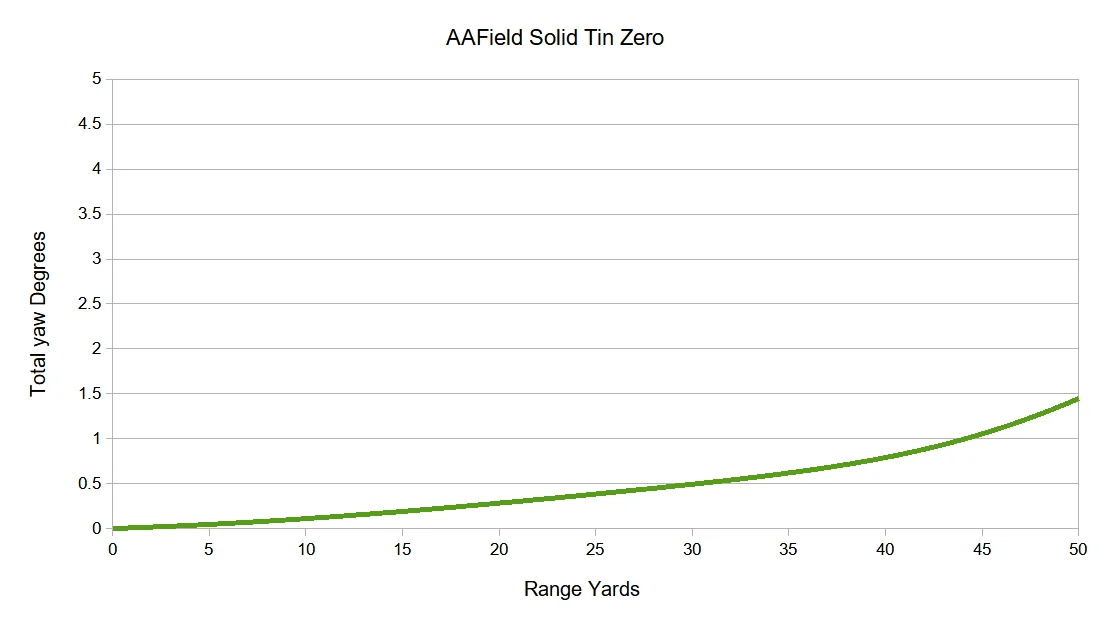
For each design I ran two simulations, one with a perfect launch with no pellet yaw or yawing rate, and one with a yaw rate of ten radians per second, a fairly high figure to show up any possible problems. I ran the same simulations for the normal lead versions of the two pellets for comparison. The muzzle energy was kept at between 11 and 12 Ft.Lbf energy for all the pellets. The diagrams below show how the pellet yaw in degrees varies over a range of 50 yards. The graphs labelled "Zero" are for pellets with a perfect launch from the gun i.e. no yaw or yaw rate at the gun, while the graphs labelled "10" are for pellets with a yaw rate of 10 radians/sec (573 degrees/sec) at the gun muzzle. If you don’t like graphs, I suggest you jump to the summary below the graphs.
The vertical yaw scale on each of the graphs has been kept the same to show the relative yaw sizes for each of the pellets.
First up is the tin AA Field design with a hollow base. The mass of this pellet is 5.7grn.


Next up is the AA Field design with the solid flare with a mass of 7.35grn.

The values for a lead AA Field are shown here for comparison.


Next is a tin version of the early JSB Heavy with a mass of 6.64grn.


Finally, for comparison, the lead version of the early JSB Heavy.


The yaw angle of a pellet is highly significant to its practical use. The higher the yaw angle, the larger the side force on a pellet, which in turn produces larger group sizes through pushing the pellet sideways. For the tin pellets, any yaw angles and thus side forces will have a larger effect than it will on the equivalent lead pellet due to the smaller mass. The problem for tin pellets is made worse by the fact that the tin pellet is also normally flying faster than the equivalent shape lead one, increasing the size of the side force for the same yaw angle. Thus, for tin pellets, any yaw angle will have a bigger effect in increasing groups sizes than it will for the equivalent lead design.
Looking at the graphs, it can be seen that in just about all of the equivalent conditions, the tin pellet has a larger yaw angle than the lead versions. Filling in the flare on the AA Field to increase the mass of the tin pellet makes matters much worse. This is because the centre of gravity of the pellet is moved backwards as the flare is filled up, making the aerodynamic and mechanical properties of the pellet much worse. It would be very difficult to find a barrel which can use such pellets effectively. Thus, it seems that it will be much more difficult to find an accurate lead free pellet than it is to find an accurate lead pellet.
The above results do not mean the tin pellet will always give bigger groups than the lead version. All the graphs are for two input conditions, one with no yaw or yaw rate i.e. a perfect launch and one with a 10 radian yaw rate. If say your gun was able to fire the tin pellet perfectly, but the lead version had the 10 radian yaw rate, then the tin pellet would perform better giving smaller group sizes.
Work now needs to be done looking at different pellet shapes and different barrel twist rates to try to find something giving the minimum group size. Getting the mass up using a diabolo pellet shape will be difficult, just filling up the flare does not appear to be a suitable method. Extending the length of the pellets may work to some extent, but then there will be problems with magazine sizes and the mechanical properties will again be made worse for small group sizes.
Still, everyone enjoys a challenge.
I have been carrying out a bit of simulation of tin pellets based on two current lead pellet designs in .177. The two designs chosen are the 8.4 grain AA Field pellet and the early JSB Heavy pellet with the cylindrical section.
To try to increase the pellet mass, I also simulated the AA Field design made of tin with much of the hollow tail section filled I, just a very short hollow section right at the end of the tail to produce a solid tin pellet. I chose this design as it has been suggested as a possible method of getting a heavier tin pellet. The early JSB Heavy design was chosen, as again, it has been suggested as a possible basis for a heavier tin pellet, and I also had some data on it. I did not model a JSB Heavy in tin with the hollow filled in, as it made little difference to the overall pellet mass.
The biggest problem for the solid design, apart from possibly needing a hammer to load it into the barrel, is the extra mass all goes in the tail, causing a large shift in the centre of gravity (CG). The CG shift has a bad effect on both the aerodynamic moments and the moments of inertia, leading to poor ballistic behaviour.
For each design I ran two simulations, one with a perfect launch with no pellet yaw or yawing rate, and one with a yaw rate of ten radians per second, a fairly high figure to show up any possible problems. I ran the same simulations for the normal lead versions of the two pellets for comparison. The muzzle energy was kept at between 11 and 12 Ft.Lbf energy for all the pellets. The diagrams below show how the pellet yaw in degrees varies over a range of 50 yards. The graphs labelled "Zero" are for pellets with a perfect launch from the gun i.e. no yaw or yaw rate at the gun, while the graphs labelled "10" are for pellets with a yaw rate of 10 radians/sec (573 degrees/sec) at the gun muzzle. If you don’t like graphs, I suggest you jump to the summary below the graphs.
The vertical yaw scale on each of the graphs has been kept the same to show the relative yaw sizes for each of the pellets.
First up is the tin AA Field design with a hollow base. The mass of this pellet is 5.7grn.
Next up is the AA Field design with the solid flare with a mass of 7.35grn.
The values for a lead AA Field are shown here for comparison.
Next is a tin version of the early JSB Heavy with a mass of 6.64grn.
Finally, for comparison, the lead version of the early JSB Heavy.
The yaw angle of a pellet is highly significant to its practical use. The higher the yaw angle, the larger the side force on a pellet, which in turn produces larger group sizes through pushing the pellet sideways. For the tin pellets, any yaw angles and thus side forces will have a larger effect than it will on the equivalent lead pellet due to the smaller mass. The problem for tin pellets is made worse by the fact that the tin pellet is also normally flying faster than the equivalent shape lead one, increasing the size of the side force for the same yaw angle. Thus, for tin pellets, any yaw angle will have a bigger effect in increasing groups sizes than it will for the equivalent lead design.
Looking at the graphs, it can be seen that in just about all of the equivalent conditions, the tin pellet has a larger yaw angle than the lead versions. Filling in the flare on the AA Field to increase the mass of the tin pellet makes matters much worse. This is because the centre of gravity of the pellet is moved backwards as the flare is filled up, making the aerodynamic and mechanical properties of the pellet much worse. It would be very difficult to find a barrel which can use such pellets effectively. Thus, it seems that it will be much more difficult to find an accurate lead free pellet than it is to find an accurate lead pellet.
The above results do not mean the tin pellet will always give bigger groups than the lead version. All the graphs are for two input conditions, one with no yaw or yaw rate i.e. a perfect launch and one with a 10 radian yaw rate. If say your gun was able to fire the tin pellet perfectly, but the lead version had the 10 radian yaw rate, then the tin pellet would perform better giving smaller group sizes.
Work now needs to be done looking at different pellet shapes and different barrel twist rates to try to find something giving the minimum group size. Getting the mass up using a diabolo pellet shape will be difficult, just filling up the flare does not appear to be a suitable method. Extending the length of the pellets may work to some extent, but then there will be problems with magazine sizes and the mechanical properties will again be made worse for small group sizes.
Still, everyone enjoys a challenge.


