Barrel harmonic tuner

The notion of a perfect pellet is what y’all would call what apparently is a very offensive word since it’s been censored LOL.. There are acceptable manufacturing tolerances. Sort a tin of pellets and see what I mean. Pellet moulds wear and change. A gun’s preference can change. New pellets come out. Sometimes pellets become unavailable. Ambient conditions change and the “perfect“ pellet suddenly is not. A few links below that demonstrate how effective a tuner can be with airguns. Different design than the OP’s because it was meant for a specific springer. But, same concept.


There's been a lot of talk at my club recently about the benefits of using a barrel tuner to tighten up groups.
There are some very good competition shooters at my club so I decided to make a tuner and let them test drive my design.
If successful I'm wondering would there be a market for them here, they would be a fraction of the price charged by manufacturers I'm thinking about £40
The tuner screws onto a standard ½ inch unf thread but they could be made as slip on to order. The brass weigh adjusts in 2mm increments, you gradually move the brass weight untill you find your optimal group size.
The theory behind barrel tuners is that you tune your barrel to match your ammunition rather than finding the perfect pellet.
Top end ft rigs such as Anschutz and Steyr are using them also common on bench rest rigs.View attachment 48221View attachment 48222View attachment 48220
Interesting. Ive looked at a few in the past and did start designing a 3D printed one but never got round to finishing it.
having looked at the FX one and the ECTuner that is sold in the states I think having a thread on the other end to fit a silencer should be an option.
You do know pellets have nothing to do with barrel harmonics. barrel harmonic waves are generated by the rifles action . which show up mainly on rifles with floating barrels . its a wave that travels down the length of the barrel producing a twitch at the end ( commonly known as muzzel flip ) most common way of solving the problem is to add a movable weight to the barrel and finding the point where it counter acts the wave . which in most cases just add a bit of droop to the barrels due to the barrel diameter.
The best way of all.. Is sorting out the rifles action . triggering . hammer and spring and exhaust valve and spring . making it all nice and smooth .
on the old forum I did a thread on this . where i generated muzzel flip and the made it go away by tuning . Somewhere i still have the video. i will see if i can find it and put it up.
View attachment 48391
Very interesting and something I had started looking into. I had read and saw somewhere about how testing a silencer and matching the silencer to the rifle can have just as much effect as testing for the correct pellet. What are you thoughts on this and I did wonder if there is merit here and what is actually happening is exactly the same as using a tuner. By this I mean that a silencer of X weight and Y length is having an effect either possitivly or negativly on harmonics.
I 3D printed one in lockdown, I did post this on the old forum.

This is what it looked like, it was just a nut to act as a weight on a thread.
View attachment 48428

View attachment 48429

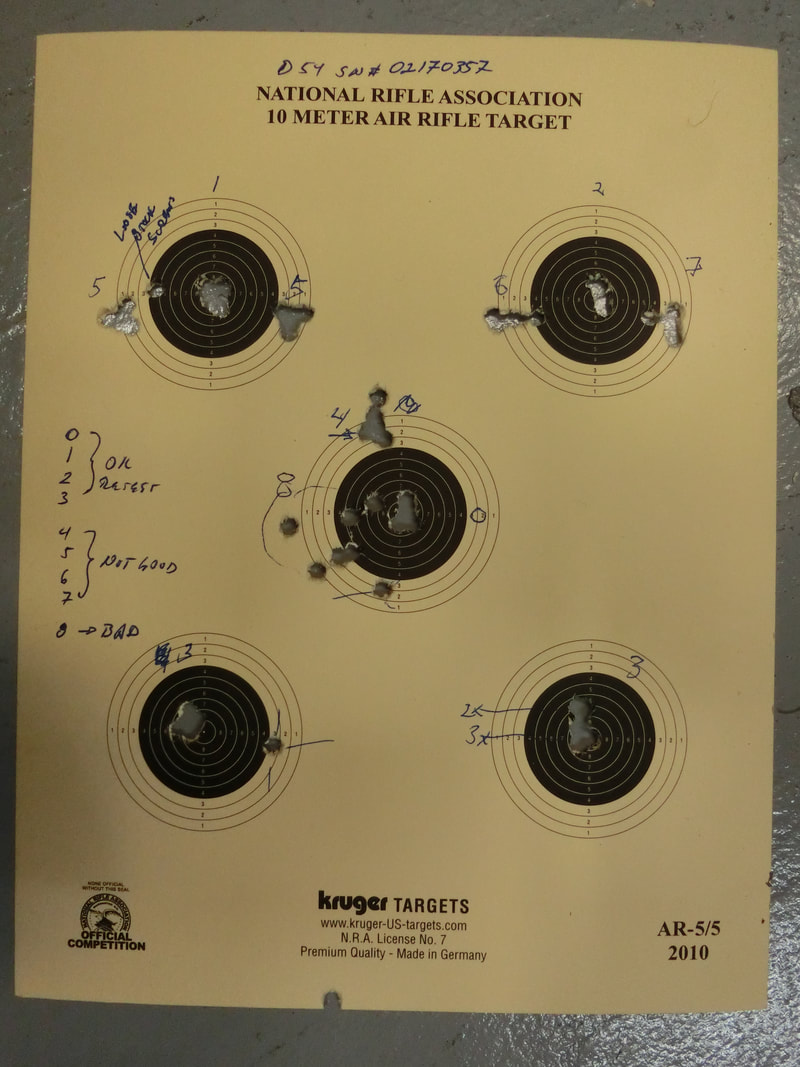
Here are some groups:

0 turns:
View attachment 48430

View attachment 48431

View attachment 48432

This was the worst setting:

View attachment 48433

This was the best setting, 3 x 5 shot groups all shot in a row:

View attachment 48434

View attachment 48435

The idiot shot was me leaning on the table too much, ignore this.

View attachment 48436

I'm a total believer in this, this was the same gun with the same pellets shot on the same day. The only thing changing was the position of the nut.

A well made posh version of this would go down very well I think. FX have launched a tuner which works on the same premise as this one, but it would look crap on most guns.
Very interesting and a well worthwhile project but the looks of things. I may have to revisit mine
Simple answer is yes .
problem 1 ...with barrel bands the barrel just sits in a steel / ali hole .ie the barrel band . not many have a O ring sat in a groove inside the hole .
Problem 2 .floating barrels .. most air gun barrels ( pcp ) are 10 to 14mm diameter and are only held at one in it the breech block by as little as 20mm .
So the longer the barrel the more whip . think of a fishing rod give the butt end a tap and watch the tip .
the idea of adding a weight just makes the tip harder to move .
where if you tune the action properly you take the butt tap away in the first place .
Smooth is aways better . this is also why the way you hold the rifle in some cases makes a difference to.. hence the saying hold sensitive rifle . 🙂👍
OK this is something I have been thinking about over the last week or so whilst designing shrouds and additional barrel bands etc...
If a barrel band has an effect on the harmonics does this also then matter where the band is positioned and how many?
Does the O ring and material of the band have major effect on this also. im thinking along the lines of 3D printed ones verses the metal ones that come as standard etc...
Also when looking at shrouds does the mechanical connection and also the location of contact points also come into play? More so if there a barrel band is attached to the shroud rather than the barrel directly

Maybe I am over thinking things and this maybe a whole different rabbit hole
 
Interesting. Ive looked at a few in the past and did start designing a 3D printed one but never got round to finishing it.
having looked at the FX one and the ECTuner that is sold in the states I think having a thread on the other end to fit a silencer should be an option.

Very interesting and something I had started looking into. I had read and saw somewhere about how testing a silencer and matching the silencer to the rifle can have just as much effect as testing for the correct pellet. What are you thoughts on this and I did wonder if there is merit here and what is actually happening is exactly the same as using a tuner. By this I mean that a silencer of X weight and Y length is having an effect either possitivly or negativly on harmonics.

Very interesting and a well worthwhile project but the looks of things. I may have to revisit mine

OK this is something I have been thinking about over the last week or so whilst designing shrouds and additional barrel bands etc...
If a barrel band has an effect on the harmonics does this also then matter where the band is positioned and how many?
Does the O ring and material of the band have major effect on this also. im thinking along the lines of 3D printed ones verses the metal ones that come as standard etc...
Also when looking at shrouds does the mechanical connection and also the location of contact points also come into play? More so if there a barrel band is attached to the shroud rather than the barrel directly

Maybe I am over thinking things and this maybe a whole different rabbit hole
" overthinking" - who knows ? Some powder guns shoot better with just a dab of bedding epoxy under the barrel @ stock end, applying pressure. Something as simple as a grub screw in a nylock nut, to tune upward pressure on the barrel, may be all that's needed...
 
The whole subject . ie ..barrel weights / adjustable barrel weights which people call harmonic tuners and silencers are full of pro's and con's . with everthing . weather springer or pcp its finding a balance.

The simple one . pcp ..floating barrel . silencer.
Steel..ali ..carbon fiber. if you make three silencers one in each . dimensional the same . the weight differences will be the telling part . your poi will shift either up or down depending on which silencer you start with .
this can be corrected and fixed with a barrel band to a set point . the internal O ring of the damps any small vibrations and returns it to it set point . where the none O ring will transmit the shock wave back into the rifle .
the O ring does not have to be a tight fit . it just needs to be a friction fit . i sure shaw 70 O rings .

Think suspension on a super bike . the balance between the preload of the spring and the setting of the dampers top and bottom of the leg has to be right . you want the bikes/riders weight to sit in the middle of the damping force . this way any shock is not transmitted to the bars . (rifle ) the bike/rider float level . this is what you want your barrel to do . you want the wave to pass without the barrel moving.

this is where the idea came from for my super accurate Mk1 Titan came from . the barrel really floats its not actually fixed . ie bolted or clamped in place .
Mk1 Titan
20220721_113702.jpg

the barrel at the front is supported by a O ring .
the back end of the barrel then sits in a carrier that moves .the carrier moves in a grease film . then after youve shoved a pellet up the pipe the barrel moves back and sits against the transfer port O ring . this allows the barrel to move about plus/ minus 5 thou linear.
20201013_193006.jpg

Building a high performance rifle is totally different to building a high precision rifle . (accurate rifle ) everything is backwards .
you use the minimum amout of power you need . this relieves the stresses and strains that cause recoil and muzzel flipp and harmonic waves .
Some times you have to look outside the air gun world to find the answers and find out how its done with other things .

@Joel484 Get back in ya box

😂🤣😂🤣😂🤣
This is a real air gun forum . we eat .sleep . shoot and write air guns .
 
Last edited:
I've always found it funny why blokes insist on free floating the Steyr when the screw at the front is called the Harmonic adjustment screw. The clue's in the title!

I've commented on this in the past but suffice to say I've found a free floating barrel to tuned pellets/harmonics can be really accurate but the Steyr using the harmonic screw is less pellet fussy. Possibly down to the decent barrel having very little movement possible beyond the harmonic screw which is why generally that screw being just nipped up lightly gives the best all round setting for various pellets. I shoot HFT/FT not BR so my tolerances are more forgiving.

*edit - tuned pellets in this instance means altering the rifles power to change the harmonics and thereby the pellet. Don't think this works, I did it on my Pro Target at the club last Sunday to demonstrate. 11.8 group on paper at 30m 10mm, power down to 11.1 group size 5.5mm with the same (bad) pellets.
 
You do know pellets have nothing to do with barrel harmonics. barrel harmonic waves are generated by the rifles action . which show up mainly on rifles with floating barrels . its a wave that travels down the length of the barrel producing a twitch at the end ( commonly known as muzzel flip ) most common way of solving the problem is to add a movable weight to the barrel and finding the point where it counter acts the wave . which in most cases just add a bit of droop to the barrels due to the barrel diameter.
The best way of all.. Is sorting out the rifles action . triggering . hammer and spring and exhaust valve and spring . making it all nice and smooth .
on the old forum I did a thread on this . where i generated muzzel flip and the made it go away by tuning . Somewhere i still have the video. i will see if i can find it and put it up.
View attachment 48391
Interesting. But with my very naughty .177 XS501 after I upped the power to just under 11ftlb, I spent days (over weeks), and a lot of cash on different pellets trying to find something that grouped. I used a weight to fine tune the best of them, half acceptably. I figured that I should see a commensurate improvement on all the others having done so, but no, different but not better. I don’t have any evidence, because the results were all so useless I walked away.

However, nobody has ever been able to explain what happens to different pellets as they travel down the barrel wrt performance, from the moment of the explosion until the moment they leave the muzzle. Plenty of logical theorising, but no proof.

I figure that different pellets induce minor differences in the explosion that is happening behind them, much the same way as putting sand bags on top of explosives gives a different result. The power may be the same, but how it releases is different, so I’d be amazed if the harmonics were exactly the same When using different pellets. But try as I might, I have never seen any detailed explanation, here or on USA forums, not that I’d understand much.

That is not to dispute that tweaking the components creating the explosion will impact it either, and I agree that harmonic tuning is worthwhile.
 
Harmonics is about tuning the rifle so that the pellet leaves the barrel at the exact same point every time during the firing cycle. If your barrel only moved in 1 plane like a pendulum an accurate rifle would be when the pellet leaves when the pendulum stalls at an end. An inaccurate one would be where the pellet leaves in the middle of the swing where the smallest difference is seen by the shooter.

This is essentially what you're doing and it can be done with weights, altering velocity or picking different pellets. You can alter when your pellet leaves the barrel with velocity or you can change where your barrel will be when this happens, the goal is the same. Get to a point where your barrel is in a "stall" point when the pellet leaves the muzzle.

This explains it better than anyone has on this thread:

Assuming you're not using totally rubbish pellets there really shouldn't be a real reason why they can't group in your rifle. This "my barrel likes Air Arms and not JSB" thing you hear isn't what it seems. It's people have found a pellet that doesn't suit the harmonics of their gun, instead of altering their rifle though most will just switch pellets to find something that suits (until they switch batches and find the same thing again).

The downside of harmonic tuning is you cannot alter anything, if you do you're starting at step 1 again. This means you will have to invest in a large number of pellets of the same batch and you can't mess around adding silencers and strippers without starting over again.

The benefit is unlocking the true potential of your rifle.

Talk of dampening your rifle and designing things with this in mind is a mute point really to 99.999% of us won't ever do this, neither do we need to. I've also seen people (youtubers) describe harmonics as setting up your valve so that you don't get any hammer bounce on firing. This is not the same thing either.

Your rifle is going to move on firing, no amount of set up and tuning will beat physics. Equal and opposite forces and all of that stuff applies to everything. Even if your barrel was perfectly stiff you would experience some harmonic effect through the action and stock, the only difference here is now you've made it harder to tune.

This is my FT gun, the barrel is 16mm. Over this is a 2mm wall stainless steel shroud, over this is a carbon fibre sleeve all epoxied together. I cannot think how you could make an airgun barrel stiffer than this and yet in the stripper you see is a small adjustable cone that can tune the gun that weighs very little. It's amazing the effect it has, it took a couple of afternoons to get it right.

And then I had to do it all again when I altered the stabiliser...

646f85d89a56ebb567d723d06f16a9a1.webp


Due to the stiffer barrel the effect was certainly less than I saw with my EV2 and the printed tuner but it was very noticeable. Groups dropped from 20mm at 50 yards to well under 10mm, I do not have the skill level shooting off my knee and outside to do any better than that.

My go to procedure for setting up a rifle now is find a batch of pellets that group the best and have no fliers (most important) and then make the rifle shoot them as well as it can.
 
Interesting. But with my very naughty .177 XS501 after I upped the power to just under 11ftlb, I spent days (over weeks), and a lot of cash on different pellets trying to find something that grouped. I used a weight to fine tune the best of them, half acceptably. I figured that I should see a commensurate improvement on all the others having done so, but no, different but not better. I don’t have any evidence, because the results were all so useless I walked away.

However, nobody has ever been able to explain what happens to different pellets as they travel down the barrel wrt performance, from the moment of the explosion until the moment they leave the muzzle. Plenty of logical theorising, but no proof.

I figure that different pellets induce minor differences in the explosion that is happening behind them, much the same way as putting sand bags on top of explosives gives a different result. The power may be the same, but how it releases is different, so I’d be amazed if the harmonics were exactly the same When using different pellets. But try as I might, I have never seen any detailed explanation, here or on USA forums, not that I’d understand much.

That is not to dispute that tweaking the components creating the explosion will impact it either, and I agree that harmonic tuning is worthwhile.
different weights and fit will change the way the pellet launches from the end of the probe. even the mount the probe pushes the pellet past the transfer port changes things . you can get into all sorts just with the way the probe is configured. thickness . to thick and it will control the air flow and expansion of the charge . ported tube tipped probes . ie . early daystates are really good at directing the charge but this put less charge to expand the pellet skirt .
the answer to the question lives in the world of springers . using different weight pellets allows you to control the rifle and the way it reacts to a certain degree just with the choice of pellet weight you can either speed up the piston or slow it down . the same can be done with an adjustable transfer port.
In a way the same actually happens in a pcp transfer system . the rifle will actually drive off ( backwards ) off a heavy tight pellet . the same way a spring rifle will drive rearward off its piston release.
then as the pellet reaches the choke depending on how tight it is you will get a slight movement forward . this is normally countered by the muzzel blast .

Its all there when you get down each rabbit hole with a shovel.
the art is putting it all together. each rifle is different. its learning the way your rifle works in fine detail and remembering it works in chains . one thing will affect another . adjust one thing then log the affect it has on the other parts of the system.
i can tell you this much . what the pellet does after launch and before hitting the choke doesn't matter as the pellets drive off the charge is diminishing as is its drag in the barrel as its been shaved and formed to the rifling .
 
Back
Top