
This is my first post in this forum and I just wanted to let you know that it's long and technical. However, the ideas are fairly basic and the most of the story is told by the figures. I learned a lot in the process of writing this post and hope that you find the long slog through it interesting and perhaps even enlightening!
My job as an experimental physicist is to come up with new measurements to observe phenomena that are hard to see. This gives us new insights and a better understanding of how the world works. The same can be applied to spring piston airguns, which can be very mysterious and enigmatic mechanical creatures! One phenomenon that is critical to the accuracy of airguns is the motion of the barrel. Where the muzzle points when a pellet leaves the barrel is probably the most important factor that decides where the pellet hits (or misses) the target. Unfortunately, this is hard to see as the muzzle vibrates very quickly with a small amplitude. In this article, I’ll describe two experiments that measure the muzzle orientation when the pellet leaves the muzzle of a Walther LGU spring piston air rifle. The first technique involves attaching different weights at the muzzle and measuring the corresponding changes in the point of impact (POI) at the target. If you have pieces of scrap metal and a way to attach them to the muzzle, you can do try this with your air rifle. The second technique involves some more advanced measurement equipment. This technique allows one to record the muzzle orientation as a function of time and determine the muzzle’s orientation at the time when the pellet leaves the barrel. Although the measurements are challenging, fun, and rewarding, this is not simply an academic exercise. These techniques allow one to tune the accuracy in a systematic way, that I have never seen before.
When measuring barrel vibrations, people usually look at the position of the muzzle. This gives a reasonable measure of the POI assuming the rest of the rifle hasn’t moved. If the muzzle height increases but the rest of the rifle is stationary the POI will go up. However, in real life, especially when dealing with spring piston air rifles, the rifle moves as well as the muzzle. For example, if the entire rifle moves up by 2 mm, the POI will move up by the same amount at ALL DISTANCES. What really matters is the orientation of the muzzle, not the position, when the pellet leaves the barrel. When we aim a rifle at a target, we don’t move the entire rifle up/down/left/right, we point the muzzle at the target! I strongly encourage you to check out and excellent article by Dr. Kolbe on how to measure the muzzle orientation (not position!) of a rifle and where the muzzle is pointing when a projectile leaves the barrel: http://www.geoffrey-kolbe.com/articles/rimfire_accuracy/tuning_a_barrel.htm
Figure 1 shows an exaggerated cartoon of the barrel flexing as the pellet leaves the muzzle. I will argue that the critical parameter is not the position of the muzzle when the pellet exits, but its angle. Of course, the two are related, but as already mentioned the entire rifle is also moving, so if one measures the muzzle to be 0.5 mm higher than its original position, part of it could be due to the barrel flexing upward but part of it could also be due to the entire rifle moving up.

The idea of standing waves and nodes in a rifle barrel is used a lot in discussing accuracy. Figure 2 shows the barrel forming a standing wave pattern that many of you have already seen. In this approach one visualizes the barrel vibrating like a string. Parts of the barrel go up and other parts go down (more on why up/down will be discussed later), with the height of the barrel at various places along the barrel greatly exaggerated so that one can see the standing wave. It’s called a standing wave because the peaks/dips do not move left or right. There are places in the wave where the barrel/string doesn’t move and these are called nodes. Halfway between the nodes, the barrel moves up and down with the greatest amplitude, and these are called antinodes. The different traces are snapshots of the wave at different times.
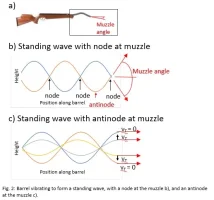
My measurements suggest that this framework isn’t very useful. Lots of people (maybe most?) think that for best accuracy, the muzzle should be at a vibration node, where it doesn’t move up or down. I have two problems with this. First of all, for a standing wave pattern to form, with nodes and antinodes, the waves in the barrel need to bounce back and forth from the ends to interfere with each other to form a standing wave. From the measurements that I made, the pellet leaves during the first oscillation of the barrel, as the initial vibration wave traveling down the barrel causes the muzzle to rise. Second, even if the barrel forms a standing wave, having the muzzle at a node could actually hurt accuracy.
Figure 2b shows the case where the muzzle is at a node (not moving up or down) in the wave pattern. Sure, the muzzle isn’t moving up or down, but at a node the orientation of the muzzle changes the most with time. So if the pellet leaves the muzzle at slightly different times, the muzzle orientation will have changed the most if it’s at a node! I don’t care much if the muzzle moves up or down a fraction of a millimeter (that will just move the POI up or down by the same amount at ALL distances), but I do care if the muzzle orientation changes, which will send the pellet in a different direction, moving the POI more at larger distances. Figure 2c shows the case where the muzzle is at an antinode, where it moves up and down the most. At an antinode, the muzzle is always pointing horizontally, but the motion of the muzzle perpendicular to the barrel will impart a transverse velocity vT to the pellet as it leaves the muzzle. This will move the pellet sideways different amounts depending on the magnitude and direction of vT. So ideally, we want the muzzle to be at an antinode (always pointing horizontal) and at a max or min of the motion (muzzle briefly stops before heading in the other direction and does not put any transverse velocity on the pellet).
As we will see, the standing wave framework is not well suited to dealing with actual barrel vibrations. I mainly brought it up to bring into question some commonly accepted ideas about barrel vibration and to get you thinking about how barrel motion affects accuracy. In the measurements that we’ll examine shortly, the muzzle angle initially goes up and then moves down. It’s certainly not an antinode (where barrel is always horizontal) but it’s not clear if it’s at a node. In any case, that kind of thinking doesn’t help us much anyway. The key to the best accuracy is to have the pellet leave the barrel when the muzzle orientation is changing the least in time. This happens at the top of a peak (or bottom of a dip) in the muzzle angle oscillation. Peaks are flat at the top, so right before the peak the muzzle angle increases more and more slowly, then at the peak the muzzle angle stays relatively constant with time, before it starts going back down again. The same argument can be used to justify the accuracy advantage of having the pellet leave the muzzle at the bottom of a dip/valley in the muzzle orientation oscillations.
So how does one ensure that the muzzle angle is the top (or bottom) of its swing? With centerfire rifles this can be done by tuning reloaded ammunition (changing powder type/weight, bullet seating depth, etc). People are also using tuners attached to the muzzle, which seem to work empirically, but it’s still not clear to me how/why they work (often incorrect arguments about standing waves are used to explain them). With spring piston air rifles, getting the pellet to leave the muzzle at a muzzle angle peak/dip can be accomplished by adding weight to the muzzle. The oscillation of the muzzle is controlled by two basic things: the stiffness of the barrel and the mass of the moving parts. One cannot readily change the barrel stiffness, but it’s easy to add weight to the muzzle, which will slow the oscillations down. The oscillation period (the time between peaks in the oscillations) is proportional to the square root of the moving mass. More mass means slower oscillations. Figure 3 shows the muzzle angle as a function of time (not the height of the barrel as function of the position of the barrel as in Fig. 2).

As the muzzle oscillates up and down, its orientation is also oscillating. In Fig. 3 with the original barrel mass (Mass 1), the pellet leaves the muzzle when it’s pointing down (negative muzzle angle). If the pellet leaves the muzzle slightly earlier, the muzzle will be pointing down even more, and if the pellet leaves the barrel at a slightly later time, the muzzle will be almost horizontal, as shown by the black dots on the blue curve. This actually could be used to compensate for slower pellets by ejecting them at a slightly higher muzzle angle (more horizontal) compared to faster pellets (point down more) to compensate for the greater drop of slower pellets at distance (please see Dr. Kolbe’s article), but in general we don’t want the launch angle to change when the pellet exit time changes a bit due to muzzle velocity changes. If we add mass to the muzzle, there is more mass to move (Mass 2 in Fig. 3), we can slow down the muzzle angle oscillations so that the pellet exits at a dip in muzzle angle. The nice thing about dips is that they are flat at the bottom, so the muzzle angle doesn’t change much for slightly longer/shorter exit times.
Before we go into measuring how the muzzle moves, let’s first think about in what direction we expect the muzzle to move. One could try to figure out all the forces acting on the barrel at different times, but that is hard. Physicists like to find the simplest answers possible! It turns out that there is a much simpler and more powerful way to think about this: symmetry. The idea of symmetry is one of the most fundamental and powerful principles in physics. It helps explain why barrels tend to vibrate vertically instead of horizontally. Most rifles are symmetrical on the left and right sides. So why would the barrel tend to favor the left or right side in its motion if both sides look exactly the same? On the other hand, rifles are highly asymmetric from top to bottom when held horizontally. The scope sits on top of the receiver, the receiver bolted to the stock, which is under the reciever, and the stock itself tends to drop at the buttpad. You can try to measure this motion with high resolution (in time and space) high speed cameras, but that is complicated and expensive. Instead, we can reveal this motion by simply adding weight to the muzzle and looking at the POI. As weight is added to the muzzle, the barrel vibrations slow down and therefore the pellet (which still takes the same amount of time to travel down the barrel) leaves the barrel when the muzzle is in at a slightly different orientation compared to the situation before the weight was added. By looking at the POI, I could keep track of the muzzle motion and confirm that for the most part, it’s vertical. This can be seen in Fig. 4 below.

I attached scrap brass to the muzzle of my LGU using the hole in the barrel shroud that was intended for the underlever latch screw (Fig. 4a). I then shot the LGU from the bench at a target 20 yards away with different masses attached to the muzzle (Fig. 4b). The POI is clearly moving up and a bit to the right as I started adding weight to the muzzle. The changes are large, with the POI moving up over an inch at 20 yards (5 MOA!) when around 100 g was added to the muzzle. There is a small horizontal component, with the POI also shifting to the right as weight is added to the muzzle. This suggests that there is a horizontal asymmetry in the rifle, otherwise there would be no reason for the barrel to pick a side when it starts moving. What could be breaking the left/right symmetry? If I had to guess, it would be the loading port in the receiver, where more metal on the right side has been removed from the receiver. A good test of this hypothesis would be to look at POI changes in a rifle where the loading port is centered symmetrically on the top of the receiver, like a HW 97. Figure 4c shows the POI as a function of added muzzle mass. I made two runs on separate days to make sure that the results were reproducible, and indeed they are.
Please see Part 2 for conitnuation
My job as an experimental physicist is to come up with new measurements to observe phenomena that are hard to see. This gives us new insights and a better understanding of how the world works. The same can be applied to spring piston airguns, which can be very mysterious and enigmatic mechanical creatures! One phenomenon that is critical to the accuracy of airguns is the motion of the barrel. Where the muzzle points when a pellet leaves the barrel is probably the most important factor that decides where the pellet hits (or misses) the target. Unfortunately, this is hard to see as the muzzle vibrates very quickly with a small amplitude. In this article, I’ll describe two experiments that measure the muzzle orientation when the pellet leaves the muzzle of a Walther LGU spring piston air rifle. The first technique involves attaching different weights at the muzzle and measuring the corresponding changes in the point of impact (POI) at the target. If you have pieces of scrap metal and a way to attach them to the muzzle, you can do try this with your air rifle. The second technique involves some more advanced measurement equipment. This technique allows one to record the muzzle orientation as a function of time and determine the muzzle’s orientation at the time when the pellet leaves the barrel. Although the measurements are challenging, fun, and rewarding, this is not simply an academic exercise. These techniques allow one to tune the accuracy in a systematic way, that I have never seen before.
When measuring barrel vibrations, people usually look at the position of the muzzle. This gives a reasonable measure of the POI assuming the rest of the rifle hasn’t moved. If the muzzle height increases but the rest of the rifle is stationary the POI will go up. However, in real life, especially when dealing with spring piston air rifles, the rifle moves as well as the muzzle. For example, if the entire rifle moves up by 2 mm, the POI will move up by the same amount at ALL DISTANCES. What really matters is the orientation of the muzzle, not the position, when the pellet leaves the barrel. When we aim a rifle at a target, we don’t move the entire rifle up/down/left/right, we point the muzzle at the target! I strongly encourage you to check out and excellent article by Dr. Kolbe on how to measure the muzzle orientation (not position!) of a rifle and where the muzzle is pointing when a projectile leaves the barrel: http://www.geoffrey-kolbe.com/articles/rimfire_accuracy/tuning_a_barrel.htm
Figure 1 shows an exaggerated cartoon of the barrel flexing as the pellet leaves the muzzle. I will argue that the critical parameter is not the position of the muzzle when the pellet exits, but its angle. Of course, the two are related, but as already mentioned the entire rifle is also moving, so if one measures the muzzle to be 0.5 mm higher than its original position, part of it could be due to the barrel flexing upward but part of it could also be due to the entire rifle moving up.
The idea of standing waves and nodes in a rifle barrel is used a lot in discussing accuracy. Figure 2 shows the barrel forming a standing wave pattern that many of you have already seen. In this approach one visualizes the barrel vibrating like a string. Parts of the barrel go up and other parts go down (more on why up/down will be discussed later), with the height of the barrel at various places along the barrel greatly exaggerated so that one can see the standing wave. It’s called a standing wave because the peaks/dips do not move left or right. There are places in the wave where the barrel/string doesn’t move and these are called nodes. Halfway between the nodes, the barrel moves up and down with the greatest amplitude, and these are called antinodes. The different traces are snapshots of the wave at different times.
My measurements suggest that this framework isn’t very useful. Lots of people (maybe most?) think that for best accuracy, the muzzle should be at a vibration node, where it doesn’t move up or down. I have two problems with this. First of all, for a standing wave pattern to form, with nodes and antinodes, the waves in the barrel need to bounce back and forth from the ends to interfere with each other to form a standing wave. From the measurements that I made, the pellet leaves during the first oscillation of the barrel, as the initial vibration wave traveling down the barrel causes the muzzle to rise. Second, even if the barrel forms a standing wave, having the muzzle at a node could actually hurt accuracy.
Figure 2b shows the case where the muzzle is at a node (not moving up or down) in the wave pattern. Sure, the muzzle isn’t moving up or down, but at a node the orientation of the muzzle changes the most with time. So if the pellet leaves the muzzle at slightly different times, the muzzle orientation will have changed the most if it’s at a node! I don’t care much if the muzzle moves up or down a fraction of a millimeter (that will just move the POI up or down by the same amount at ALL distances), but I do care if the muzzle orientation changes, which will send the pellet in a different direction, moving the POI more at larger distances. Figure 2c shows the case where the muzzle is at an antinode, where it moves up and down the most. At an antinode, the muzzle is always pointing horizontally, but the motion of the muzzle perpendicular to the barrel will impart a transverse velocity vT to the pellet as it leaves the muzzle. This will move the pellet sideways different amounts depending on the magnitude and direction of vT. So ideally, we want the muzzle to be at an antinode (always pointing horizontal) and at a max or min of the motion (muzzle briefly stops before heading in the other direction and does not put any transverse velocity on the pellet).
As we will see, the standing wave framework is not well suited to dealing with actual barrel vibrations. I mainly brought it up to bring into question some commonly accepted ideas about barrel vibration and to get you thinking about how barrel motion affects accuracy. In the measurements that we’ll examine shortly, the muzzle angle initially goes up and then moves down. It’s certainly not an antinode (where barrel is always horizontal) but it’s not clear if it’s at a node. In any case, that kind of thinking doesn’t help us much anyway. The key to the best accuracy is to have the pellet leave the barrel when the muzzle orientation is changing the least in time. This happens at the top of a peak (or bottom of a dip) in the muzzle angle oscillation. Peaks are flat at the top, so right before the peak the muzzle angle increases more and more slowly, then at the peak the muzzle angle stays relatively constant with time, before it starts going back down again. The same argument can be used to justify the accuracy advantage of having the pellet leave the muzzle at the bottom of a dip/valley in the muzzle orientation oscillations.
So how does one ensure that the muzzle angle is the top (or bottom) of its swing? With centerfire rifles this can be done by tuning reloaded ammunition (changing powder type/weight, bullet seating depth, etc). People are also using tuners attached to the muzzle, which seem to work empirically, but it’s still not clear to me how/why they work (often incorrect arguments about standing waves are used to explain them). With spring piston air rifles, getting the pellet to leave the muzzle at a muzzle angle peak/dip can be accomplished by adding weight to the muzzle. The oscillation of the muzzle is controlled by two basic things: the stiffness of the barrel and the mass of the moving parts. One cannot readily change the barrel stiffness, but it’s easy to add weight to the muzzle, which will slow the oscillations down. The oscillation period (the time between peaks in the oscillations) is proportional to the square root of the moving mass. More mass means slower oscillations. Figure 3 shows the muzzle angle as a function of time (not the height of the barrel as function of the position of the barrel as in Fig. 2).
As the muzzle oscillates up and down, its orientation is also oscillating. In Fig. 3 with the original barrel mass (Mass 1), the pellet leaves the muzzle when it’s pointing down (negative muzzle angle). If the pellet leaves the muzzle slightly earlier, the muzzle will be pointing down even more, and if the pellet leaves the barrel at a slightly later time, the muzzle will be almost horizontal, as shown by the black dots on the blue curve. This actually could be used to compensate for slower pellets by ejecting them at a slightly higher muzzle angle (more horizontal) compared to faster pellets (point down more) to compensate for the greater drop of slower pellets at distance (please see Dr. Kolbe’s article), but in general we don’t want the launch angle to change when the pellet exit time changes a bit due to muzzle velocity changes. If we add mass to the muzzle, there is more mass to move (Mass 2 in Fig. 3), we can slow down the muzzle angle oscillations so that the pellet exits at a dip in muzzle angle. The nice thing about dips is that they are flat at the bottom, so the muzzle angle doesn’t change much for slightly longer/shorter exit times.
Before we go into measuring how the muzzle moves, let’s first think about in what direction we expect the muzzle to move. One could try to figure out all the forces acting on the barrel at different times, but that is hard. Physicists like to find the simplest answers possible! It turns out that there is a much simpler and more powerful way to think about this: symmetry. The idea of symmetry is one of the most fundamental and powerful principles in physics. It helps explain why barrels tend to vibrate vertically instead of horizontally. Most rifles are symmetrical on the left and right sides. So why would the barrel tend to favor the left or right side in its motion if both sides look exactly the same? On the other hand, rifles are highly asymmetric from top to bottom when held horizontally. The scope sits on top of the receiver, the receiver bolted to the stock, which is under the reciever, and the stock itself tends to drop at the buttpad. You can try to measure this motion with high resolution (in time and space) high speed cameras, but that is complicated and expensive. Instead, we can reveal this motion by simply adding weight to the muzzle and looking at the POI. As weight is added to the muzzle, the barrel vibrations slow down and therefore the pellet (which still takes the same amount of time to travel down the barrel) leaves the barrel when the muzzle is in at a slightly different orientation compared to the situation before the weight was added. By looking at the POI, I could keep track of the muzzle motion and confirm that for the most part, it’s vertical. This can be seen in Fig. 4 below.
I attached scrap brass to the muzzle of my LGU using the hole in the barrel shroud that was intended for the underlever latch screw (Fig. 4a). I then shot the LGU from the bench at a target 20 yards away with different masses attached to the muzzle (Fig. 4b). The POI is clearly moving up and a bit to the right as I started adding weight to the muzzle. The changes are large, with the POI moving up over an inch at 20 yards (5 MOA!) when around 100 g was added to the muzzle. There is a small horizontal component, with the POI also shifting to the right as weight is added to the muzzle. This suggests that there is a horizontal asymmetry in the rifle, otherwise there would be no reason for the barrel to pick a side when it starts moving. What could be breaking the left/right symmetry? If I had to guess, it would be the loading port in the receiver, where more metal on the right side has been removed from the receiver. A good test of this hypothesis would be to look at POI changes in a rifle where the loading port is centered symmetrically on the top of the receiver, like a HW 97. Figure 4c shows the POI as a function of added muzzle mass. I made two runs on separate days to make sure that the results were reproducible, and indeed they are.
Please see Part 2 for conitnuation


