
• the Daily hi thread just say hi :)
  • Welcome to the UK's Most Active Airgun Forum

    Looking for expert advice on air rifles and shooting gear? You have found the internet's premier independent airgun forum. Our active shooting community shares daily technical insights on modular PCP air rifles, spring-powered rifles, air pistols, pellet testing, and optics setup. Whether you are troubleshooting an FX or Daystate regulator, discussing legal FAC requirements, planning a night vision hunting trip, or looking for pest control tips, our members are here to help.

Chat-GPT: asking it air rifle questions

BrettMRC

Top Tier member
Honorary
Joined
Jul 7, 2022
Messages
3,722
Reaction score
12,294
Points
250
Location
Yeovilton-ish
Just having a play about:


ME:
If my zero is at 20 yards with a .22 air rifle, firing pellets at 615 feet per second, where should I aim if the target moves to 10 yards?


CHAT GPT:

To calculate where to aim when shooting at a target that has moved closer, you need to take into account the trajectory of the pellet and the distance to the target.
Assuming a standard .22 pellet with a ballistic coefficient of 0.017, fired from a rifle with a muzzle velocity of 615 feet per second, the pellet will drop approximately 0.4 inches at 20 yards and 1.6 inches at 30 yards.
To calculate where to aim at a target 10 yards away, you can use a ballistic calculator or table for your specific pellet and rifle combination. Alternatively, you can estimate the holdover required based on the trajectory of the pellet.
Assuming a straight-line trajectory at short distances, you can estimate that the pellet will drop around 0.1 inches at 10 yards. Therefore, to hit the target at 10 yards, you should aim approximately 0.1 inches above where you would aim at 20 yards.
Note that this is just an estimation and may not be accurate for all pellet and rifle combinations. It is important to practice shooting at different distances and adjust your aim accordingly to improve your accuracy.
 
Just having a play about:


ME:
If my zero is at 20 yards with a .22 air rifle, firing pellets at 615 feet per second, where should I aim if the target moves to 10 yards?


CHAT GPT:

To calculate where to aim when shooting at a target that has moved closer, you need to take into account the trajectory of the pellet and the distance to the target.
Assuming a standard .22 pellet with a ballistic coefficient of 0.017, fired from a rifle with a muzzle velocity of 615 feet per second, the pellet will drop approximately 0.4 inches at 20 yards and 1.6 inches at 30 yards.
To calculate where to aim at a target 10 yards away, you can use a ballistic calculator or table for your specific pellet and rifle combination. Alternatively, you can estimate the holdover required based on the trajectory of the pellet.
Assuming a straight-line trajectory at short distances, you can estimate that the pellet will drop around 0.1 inches at 10 yards. Therefore, to hit the target at 10 yards, you should aim approximately 0.1 inches above where you would aim at 20 yards.
Note that this is just an estimation and may not be accurate for all pellet and rifle combinations. It is important to practice shooting at different distances and adjust your aim accordingly to improve your accuracy.
Scary 😱. I knew the machines would take over one day but looks like it will be sooner than I thought πŸ˜‰.
 
Just having a play about:


ME:
If my zero is at 20 yards with a .22 air rifle, firing pellets at 615 feet per second, where should I aim if the target moves to 10 yards?


CHAT GPT:

To calculate where to aim when shooting at a target that has moved closer, you need to take into account the trajectory of the pellet and the distance to the target.
Assuming a standard .22 pellet with a ballistic coefficient of 0.017, fired from a rifle with a muzzle velocity of 615 feet per second, the pellet will drop approximately 0.4 inches at 20 yards and 1.6 inches at 30 yards.
To calculate where to aim at a target 10 yards away, you can use a ballistic calculator or table for your specific pellet and rifle combination. Alternatively, you can estimate the holdover required based on the trajectory of the pellet.
Assuming a straight-line trajectory at short distances, you can estimate that the pellet will drop around 0.1 inches at 10 yards. Therefore, to hit the target at 10 yards, you should aim approximately 0.1 inches above where you would aim at 20 yards.
Note that this is just an estimation and may not be accurate for all pellet and rifle combinations. It is important to practice shooting at different distances and adjust your aim accordingly to improve your accuracy.
Chairguns just run off screaming πŸ˜‚πŸ€£πŸ˜‚πŸ€£
 
I think the data it works from is only up to the end of 2021...
 
Ask it "What is better: .177 or .22?" 🍿

I asked........

ME:
Which air rifle calibre is better, .177 or .22?


CHAT-GPT:
The choice between a .177 and a .22 air rifle caliber largely depends on your intended use and personal preferences.
In general, a .177 caliber air rifle will be more suitable for target shooting, pest control, and small game hunting at shorter distances. This is because the .177 pellet has a flatter trajectory and a higher velocity, which results in less drop over shorter ranges and greater accuracy.
On the other hand, a .22 caliber air rifle is more suitable for larger game hunting, especially at longer distances. This is because the .22 pellet is heavier and slower, which makes it more stable and less affected by wind drift over longer distances. It also delivers more energy upon impact, which is important for taking down larger animals.
Ultimately, the best caliber for you depends on your individual needs and preferences. If you're unsure which caliber to choose, it's recommended that you consult with an experienced air gun enthusiast or professional to help you make an informed decision.
 
Watch this. The woman talking is AI.

Some scary shit coming in the near future methinks….apologies for the length of it but it is fascinating….

 
That's a politicians answer.
Told you everything except the answer to your question. πŸ₯΄
Actually it did give the right answer. not knowing what you were shooting at . i would have been shocked if it had said one or the other . as it would have been wrong not knowing the parameters.
very clever.
 
πŸ™‚ Im looking forward to the day it can do designs and print them out . .
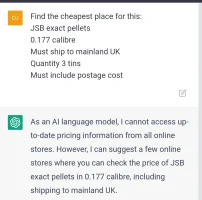
Computer design me a PCP high precision rifle. and write cad progs for parts manufacture. Sorted πŸ€£πŸ˜‚πŸ€£πŸ˜‚πŸ€£πŸ˜‚
I just tried it to write the code for an Arduino microprocessor control to measure moisture content of soil and turn on the water if too dry and turn off if wet enough.

It worked!
 
CHAT-GPT:
The choice between a .177 and a .22 air rifle caliber largely depends on your intended use and personal preferences.
In general, a .177 caliber air rifle will be more suitable for target shooting, pest control, and small game hunting at shorter distances. This is because the .177 pellet has a flatter trajectory and a higher velocity, which results in less drop over shorter ranges and greater accuracy.
On the other hand, a .22 caliber air rifle is more suitable for larger game hunting, especially at longer distances. This is because the .22 pellet is heavier and slower, which makes it more stable and less affected by wind drift over longer distances. It also delivers more energy upon impact, which is important for taking down larger animals.
Ultimately, the best caliber for you depends on your individual needs and preferences. If you're unsure which caliber to choose, it's recommended that you consult with an experienced air gun enthusiast or professional to help you make an informed decision.

Sounds like Dr B answered that question Ha! Ha! Ha!
 
Back
Top