
Continuation from Part 1:
Adding weight to the muzzle and looking for POI changes can be done very easily, and I encourage you to try it to map out the vibrations of your air rifle’s muzzle using this approach. To measure the muzzle angle as a function of time and check when the pellet leaves the barrel involves some more advanced techniques. I used the ingenious crossed-polarizer setup that was described by Dr. Kolbe in the article that I mentioned earlier. I already posted some results on this technique in https://shooting-the-breeze.com/threads/barrel-vibration-measurements-in-my-lgu.52757/.
Figure 5 shows the muzzle angle measurements. There’s a lot of information to unpack here, so please be patient as we go through the data in detail. I simultaneously measure three quantities in Fig. 5. A microphone is placed at the rear of the receiver to pick up sounds that the rifle is making, like the click of the sear, which is used to trigger the oscilloscope to start recording data. The microphone signal is the top blue trace in the graphs in Fig. 5a-c. The microphone also picks up multiple piston bounces! The second, orange trace in the Fig. 5a-c graphs shows the muzzle orientation as a function of time. Although the muzzle angle signal is not calibrated, we know from the POI measurements in Fig. 4c that the amplitude of the oscillations is around 5 MOA. The lowest gray trace shows the signal from two light gates (LG1 and LG2) that were placed 6” and 28.5” in front of the muzzle. Each spike in the light gate signal occurs when the pellet passes through a light gate, and this allows one to precisely determine when the pellet left the muzzle (about 0.5 milliseconds before the LG1 spike, indicated by the yellow vertical line). As mass is added to the muzzle, the oscillations in the orange curves shift slightly to the right (later times) as the muzzle oscillations slow down. Since the pellet still leaves at the same time, the pellet exit moves to the left on these curves. The muzzle angle when the pellet leaves the barrel is determined by the place where the yellow vertical line (pellet exit time) intersects the orange muzzle angle curve.

In Fig. 5a, the pellet leaves the muzzle when the muzzle angle is near a minimum, resulting in a lower POI. Adding 145 g to muzzle causes the pellet to leave the muzzle near a peak in the muzzle angle (just to the left of the earlier dip). This results in a higher POI. Note that the shape of the oscillations in Fig. 5a and b has not changed much. This shift of the pellet exit on the muzzle angle traces can be seen better in closeups of these graphs in Fig. 5e. When 333 g is added to the muzzle, the muzzle angle oscillation amplitude decreases and the detailed shape changes, but one still can see the broad muzzle angle maxima (at around 0.008s and 0.024s) and minima (at around 0.016s and 0.032s), similar to the graphs in Fig. 5 a and b. The pellet exit time is even further to the left on the first broad maximum and occurs at a muzzle angle that is higher than for the case were no weight is added but lower than for the case where 145 g is added. While recording these traces, I roughly aimed the rifle at a target that was 20 yards away, mainly to make sure that the pellet would go through the narrow light gates. One can clearly see the POI moving in a diagonal line at the target as weight was added to the muzzle in Fig. 5 d.
According to these measurements and the arguments that I made earlier in this article, the situation where no mass is added to the muzzle is not ideal for best accuracy and consistency. The pellet exits just before the muzzle angle reaches a minimum (see left graph in Fig. 5e). The muzzle angle changes fairly rapidly at this time (slope of orange curve is large), so small changes in the pellet exit times will results in more significant changes in the muzzle angle when the pellet leaves the barrel. Of course, the magnitude of these changes depends on how much muzzle velocity fluctuates. The standard deviation in my LGU’s muzzle velocity is around 4 fps and the extreme spread is around 13 fps for 20 shots. A difference of 20 fps in muzzle velocity changes the pellet exit time by only around 0.05 milliseconds. So on the time scale of the oscillations, the muzzle angle will not change much with typical muzzle velocity fluctuations. What concerns me more are systematic changes that result from shooting on a hotter day or at a higher altitude, which can significantly shift the average muzzle velocity (and therefore the pellet exit time). This would produce a shift in the POI that is more sensitive to the ambient conditions. I have seen shifts of around 1 MOA at field target matches on hotter days. Some of this may be the scope and its mounts (please see https://shooting-the-breeze.com/threads/sightron-poi-shift-with-temperature.61030/), but it certainly would help if the muzzle angle was less sensitive to the pellet exit time, i.e., pellet leaves the muzzle at a peak or dip in the muzzle angle oscillation.
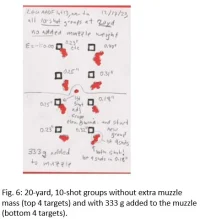
So did all this work make any difference? I would argue that my increased understanding how my LGU behaves makes it worthwhile in its own right. Also, this approach could offer a new (at least to me) and systematic way to tune target air rifles. In Fig. 6 I tested the accuracy of my LGU without and with added muzzle mass. First of all, how much mass should I add? One could argue that since the POI as a function of added muzzle mass flattened out at around 100 g (Fig. 4c), that is the mass we should use. That would make sense if I was dealing with fluctuations in muzzle mass, in which case the POI wouldn’t change much if the added muzzle mass went from 100 g to 120 g. However, the muzzle mass is very precisely fixed and constant, what is changing is pellet muzzle velocity, so we need to look at the muzzle angle vs time, not the muzzle angle vs added mass! With 145 g added to the muzzle (close to the POI vs added mass peak) the pellet exit is on a fairly sharp and narrow peak, so it would be better to move pellet exit to the broader portion of the muzzle angle vs time trace, to the left of that sharp peak by adding more mass. I chose 333 for two reasons. First of all, the overall amplitude of the muzzle angle oscillations was significantly lower for this heavier mass (see Fig. 5 a-c). Second, the pellet exit is near the bottom of a smaller dip (see Fig. 5c) in the muzzle angle oscillations.
All groups are 10 shots (not 5!) from 20 yards off the bench. The top four groups are without added muzzle mass and serve as a control. The bottom four groups are with 333 g added to the muzzle. The center-to-center (ctc) average for the top four groups is 0.30” ± 0.08” while the ctc average for the bottom four groups is 0.24” ± 0.06”. This is not a huge deal and I think the bottom four groups would look even better if one measured the average distance to center of each group (the 10th shot in the last group opened it up from 0.18” ctc to 0.32”). In the top four groups, more than one shot tended to spread the groups out. Also, the position of the lower four groups relative to the aiming squares seemed to be more consistent.
Satisfied that things are actually working, I built a homemade muzzle mass that screws more securely into two holes in the barrel shroud, as shown in Fig. 7a. I also added another rare earth magnet on the steel muzzle weight to secure the underlever better. I originally used only a computer hard drive magnet to hold the underlever, but it didn’t hold the lever very securely; the underlever would separate from the barrel with a sharp rap on the bottom of the stock. The muzzle weight is threaded to allow attaching more weight, but I did an accuracy test with the bare muzzle weight, which has a mass of 240 g. Figure 7b shows the accuracy test with 10-shot groups at 20 yards. I used a new tin of Air Arms Diabolo Field Target pellets; I usually find better accuracy with a new tin. Maybe the pellets had less chance to deform while packed together more tightly in a newly opened tin? If you have similar experience and have any ideas why this could be happening, I’d love to know! As with the last accuracy test in Fig. 6, in Fig. 7 the first four groups were with the bare muzzle and the last four groups were with my new 240 g DIY muzzle weight added to the barrel. Both configurations were quite good for a springer, with the average ctc for the bare muzzle being 0.24”±0.06” and the average ctc when the muzzle weight was added being 0.19”±0.04”. Except for the group on the lower left, the groups with the muzzle weight are much rounder than what I typically get with my LGU, suggesting that the dispersion is mainly due to small random error rather than systematic problems. In the lower left group, the first few shots were high before the POI settled to the lower spot where all the other groups tended to be. Remember, these are 10-shot groups at 20 yards with a springer.

Springers are notoriously tricky to tune, so I’m very excited about this simple, systematic approach to get the muzzle to vibrate in your favor. Of course, we need a rifle that is already reasonably accurate and well-behaved. If the dispersion of the groups is already a few MOA, seeing small changes due to added muzzle weight will not be observable and there probably are bigger problems that will not be solved by adding weight to the muzzle. However, if you have a reasonably accurate air rifle, you may want to see what adding different weights to the muzzle does!
Adding weight to the muzzle and looking for POI changes can be done very easily, and I encourage you to try it to map out the vibrations of your air rifle’s muzzle using this approach. To measure the muzzle angle as a function of time and check when the pellet leaves the barrel involves some more advanced techniques. I used the ingenious crossed-polarizer setup that was described by Dr. Kolbe in the article that I mentioned earlier. I already posted some results on this technique in https://shooting-the-breeze.com/threads/barrel-vibration-measurements-in-my-lgu.52757/.
Figure 5 shows the muzzle angle measurements. There’s a lot of information to unpack here, so please be patient as we go through the data in detail. I simultaneously measure three quantities in Fig. 5. A microphone is placed at the rear of the receiver to pick up sounds that the rifle is making, like the click of the sear, which is used to trigger the oscilloscope to start recording data. The microphone signal is the top blue trace in the graphs in Fig. 5a-c. The microphone also picks up multiple piston bounces! The second, orange trace in the Fig. 5a-c graphs shows the muzzle orientation as a function of time. Although the muzzle angle signal is not calibrated, we know from the POI measurements in Fig. 4c that the amplitude of the oscillations is around 5 MOA. The lowest gray trace shows the signal from two light gates (LG1 and LG2) that were placed 6” and 28.5” in front of the muzzle. Each spike in the light gate signal occurs when the pellet passes through a light gate, and this allows one to precisely determine when the pellet left the muzzle (about 0.5 milliseconds before the LG1 spike, indicated by the yellow vertical line). As mass is added to the muzzle, the oscillations in the orange curves shift slightly to the right (later times) as the muzzle oscillations slow down. Since the pellet still leaves at the same time, the pellet exit moves to the left on these curves. The muzzle angle when the pellet leaves the barrel is determined by the place where the yellow vertical line (pellet exit time) intersects the orange muzzle angle curve.
In Fig. 5a, the pellet leaves the muzzle when the muzzle angle is near a minimum, resulting in a lower POI. Adding 145 g to muzzle causes the pellet to leave the muzzle near a peak in the muzzle angle (just to the left of the earlier dip). This results in a higher POI. Note that the shape of the oscillations in Fig. 5a and b has not changed much. This shift of the pellet exit on the muzzle angle traces can be seen better in closeups of these graphs in Fig. 5e. When 333 g is added to the muzzle, the muzzle angle oscillation amplitude decreases and the detailed shape changes, but one still can see the broad muzzle angle maxima (at around 0.008s and 0.024s) and minima (at around 0.016s and 0.032s), similar to the graphs in Fig. 5 a and b. The pellet exit time is even further to the left on the first broad maximum and occurs at a muzzle angle that is higher than for the case were no weight is added but lower than for the case where 145 g is added. While recording these traces, I roughly aimed the rifle at a target that was 20 yards away, mainly to make sure that the pellet would go through the narrow light gates. One can clearly see the POI moving in a diagonal line at the target as weight was added to the muzzle in Fig. 5 d.
According to these measurements and the arguments that I made earlier in this article, the situation where no mass is added to the muzzle is not ideal for best accuracy and consistency. The pellet exits just before the muzzle angle reaches a minimum (see left graph in Fig. 5e). The muzzle angle changes fairly rapidly at this time (slope of orange curve is large), so small changes in the pellet exit times will results in more significant changes in the muzzle angle when the pellet leaves the barrel. Of course, the magnitude of these changes depends on how much muzzle velocity fluctuates. The standard deviation in my LGU’s muzzle velocity is around 4 fps and the extreme spread is around 13 fps for 20 shots. A difference of 20 fps in muzzle velocity changes the pellet exit time by only around 0.05 milliseconds. So on the time scale of the oscillations, the muzzle angle will not change much with typical muzzle velocity fluctuations. What concerns me more are systematic changes that result from shooting on a hotter day or at a higher altitude, which can significantly shift the average muzzle velocity (and therefore the pellet exit time). This would produce a shift in the POI that is more sensitive to the ambient conditions. I have seen shifts of around 1 MOA at field target matches on hotter days. Some of this may be the scope and its mounts (please see https://shooting-the-breeze.com/threads/sightron-poi-shift-with-temperature.61030/), but it certainly would help if the muzzle angle was less sensitive to the pellet exit time, i.e., pellet leaves the muzzle at a peak or dip in the muzzle angle oscillation.
So did all this work make any difference? I would argue that my increased understanding how my LGU behaves makes it worthwhile in its own right. Also, this approach could offer a new (at least to me) and systematic way to tune target air rifles. In Fig. 6 I tested the accuracy of my LGU without and with added muzzle mass. First of all, how much mass should I add? One could argue that since the POI as a function of added muzzle mass flattened out at around 100 g (Fig. 4c), that is the mass we should use. That would make sense if I was dealing with fluctuations in muzzle mass, in which case the POI wouldn’t change much if the added muzzle mass went from 100 g to 120 g. However, the muzzle mass is very precisely fixed and constant, what is changing is pellet muzzle velocity, so we need to look at the muzzle angle vs time, not the muzzle angle vs added mass! With 145 g added to the muzzle (close to the POI vs added mass peak) the pellet exit is on a fairly sharp and narrow peak, so it would be better to move pellet exit to the broader portion of the muzzle angle vs time trace, to the left of that sharp peak by adding more mass. I chose 333 for two reasons. First of all, the overall amplitude of the muzzle angle oscillations was significantly lower for this heavier mass (see Fig. 5 a-c). Second, the pellet exit is near the bottom of a smaller dip (see Fig. 5c) in the muzzle angle oscillations.
All groups are 10 shots (not 5!) from 20 yards off the bench. The top four groups are without added muzzle mass and serve as a control. The bottom four groups are with 333 g added to the muzzle. The center-to-center (ctc) average for the top four groups is 0.30” ± 0.08” while the ctc average for the bottom four groups is 0.24” ± 0.06”. This is not a huge deal and I think the bottom four groups would look even better if one measured the average distance to center of each group (the 10th shot in the last group opened it up from 0.18” ctc to 0.32”). In the top four groups, more than one shot tended to spread the groups out. Also, the position of the lower four groups relative to the aiming squares seemed to be more consistent.
Satisfied that things are actually working, I built a homemade muzzle mass that screws more securely into two holes in the barrel shroud, as shown in Fig. 7a. I also added another rare earth magnet on the steel muzzle weight to secure the underlever better. I originally used only a computer hard drive magnet to hold the underlever, but it didn’t hold the lever very securely; the underlever would separate from the barrel with a sharp rap on the bottom of the stock. The muzzle weight is threaded to allow attaching more weight, but I did an accuracy test with the bare muzzle weight, which has a mass of 240 g. Figure 7b shows the accuracy test with 10-shot groups at 20 yards. I used a new tin of Air Arms Diabolo Field Target pellets; I usually find better accuracy with a new tin. Maybe the pellets had less chance to deform while packed together more tightly in a newly opened tin? If you have similar experience and have any ideas why this could be happening, I’d love to know! As with the last accuracy test in Fig. 6, in Fig. 7 the first four groups were with the bare muzzle and the last four groups were with my new 240 g DIY muzzle weight added to the barrel. Both configurations were quite good for a springer, with the average ctc for the bare muzzle being 0.24”±0.06” and the average ctc when the muzzle weight was added being 0.19”±0.04”. Except for the group on the lower left, the groups with the muzzle weight are much rounder than what I typically get with my LGU, suggesting that the dispersion is mainly due to small random error rather than systematic problems. In the lower left group, the first few shots were high before the POI settled to the lower spot where all the other groups tended to be. Remember, these are 10-shot groups at 20 yards with a springer.
Springers are notoriously tricky to tune, so I’m very excited about this simple, systematic approach to get the muzzle to vibrate in your favor. Of course, we need a rifle that is already reasonably accurate and well-behaved. If the dispersion of the groups is already a few MOA, seeing small changes due to added muzzle weight will not be observable and there probably are bigger problems that will not be solved by adding weight to the muzzle. However, if you have a reasonably accurate air rifle, you may want to see what adding different weights to the muzzle does!


